What is SaaS Development? How We Build Cloud-Native Products
A comprehensive deep dive into SaaS development, covering multi-tenancy, serverless architectures, database partitioning, and strategies for building resilient cloud-native products.
What is SaaS Development? How We Build Cloud-Native Products
Software as a Service (SaaS) has completely redefined how businesses and individuals interact with technology. Instead of purchasing software licenses, downloading local installers, and manually deploying local databases, users now expect to access rich web applications instantly through their browser or mobile app.
Behind the scenes, building a successful, enterprise-grade SaaS product is a complex undertaking. It requires more than just creating a functional interface; it demands a scalable, highly secure, and cost-efficient architecture that can support thousands of clients (tenants) simultaneously.
At VSNEXOS, we specialize in engineering cloud-native SaaS products that scale automatically, guarantee data separation, and deliver high performance. In this article, we explain the core principles of SaaS development and provide a blueprint for how we build modern cloud-native systems.
What Does "Cloud-Native" Mean?
To understand SaaS architecture, we must first define what makes a product "cloud-native."
Historically, cloud migration involved taking a legacy desktop application and hosting it on a virtual server in the cloud (often referred to as a "lift-and-shift" migration). While this allows remote access, it doesn't take advantage of cloud features.
A cloud-native application is designed from day one to live in the cloud. It leverages managed services, serverless computing, microservices, containerization, and automated scaling. Key attributes include:
- Microservices Architecture: Splitting the application into small, independent services (e.g., authentication, billing, notifications, search) that communicate via APIs. If one service encounters an issue, the rest of the application remains functional.
- Containerization (Docker & Kubernetes): Packaging code and dependencies into standard containers that run consistently across any cloud provider, enabling fast deployments and automatic scaling.
- Serverless Computing: Using serverless components (like AWS Lambda or Vercel Edge Functions) that run code only when triggered by requests, reducing idle server costs to zero.
- DevOps Automation: Utilizing continuous integration and continuous deployment (CI/CD) pipelines to test and deploy code changes automatically, minimizing human error.
The Core Challenge: Tenant Isolation (Multi-Tenancy)
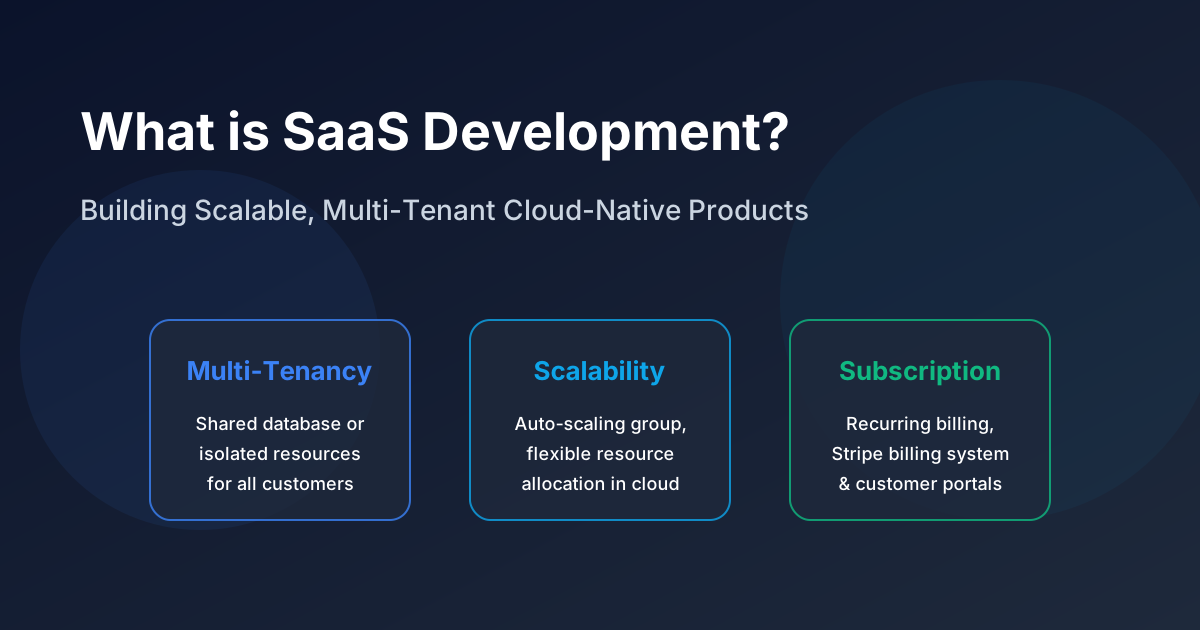
The defining characteristic of SaaS is multi-tenancy—a single instance of the software serving multiple customers (tenants). The main architectural decision during SaaS planning is deciding how to partition data between these tenants.
There are three primary models for database multi-tenancy:
1. Database-Per-Tenant (Isolated Databases)
In this model, every customer gets their own database. The application layer routes traffic dynamically to the correct database based on the user's tenant ID.
- Pros: Maximum security, complete data isolation, easy compliance, custom backup schedules per tenant.
- Cons: High cost (requires many database instances), complex schema migrations (updating tables across hundreds of databases).
2. Schema-Per-Tenant (Shared Database, Separate Schemas)
Tenants share a database instance, but their tables are separated into distinct database schemas.
- Pros: Moderate cost, decent isolation, easier database management.
- Cons: Harder to scale horizontally if a single database instance runs out of CPU/memory.
3. Shared Database, Shared Schema (Row-Level Multi-Tenancy)
All tenants share the same tables. Every table includes a tenant_id column to identify which customer owns the row. The application filters queries dynamically (SELECT * FROM orders WHERE tenant_id = 'XYZ').
- Pros: Extremely low cost, simple maintenance, easy to scale.
- Cons: Highest security risk. A bug in the application layer filter could accidentally expose customer A's data to customer B (known as a "noisy neighbor" or data leakage issue).
How VSNEXOS Solves Tenant Isolation
For standard business SaaS products, we use the Shared Database, Shared Schema model paired with Row-Level Security (RLS) in PostgreSQL. This allows us to enforce data boundaries directly at the database engine level, preventing any application-level bugs from exposing data across tenants. For enterprise clients with strict compliance needs, we implement dedicated VPCs and isolated databases.
Step-by-Step Blueprint for Building SaaS Products
When building a new SaaS product, we follow a modular blueprint to ensure the core foundations are solid before developing specific business features:
graph TD
    A[Identity & Auth] --> B[Multi-Tenant Router]
    B --> C[Billing & Subscriptions]
    C --> D[Feature Flags & Access]
    D --> E[Core SaaS Features]
    E --> F[API Gateway & Telemetry]
Step 1: Secure Identity & Authentication (AuthN/AuthZ)
We decouple authentication from the core application by using specialized providers like Auth0, Clerk, or Supabase Auth. We implement Role-Based Access Control (RBAC) to define granular permissions (e.g., admin, editor, billing manager) within each tenant organization.
Step 2: Automated Subscription & Billing Billing
We integrate payment orchestrators like Stripe or Razorpay. The system maps customer subscriptions directly to feature permissions. If a customer upgrades, the application unlocks premium modules automatically. We also handle edge cases like failed renewals, card expirations, and prorated billings.
Step 3: Feature Flags and Entitlements
Using feature flagging systems, we can toggle specific product features on and off for individual accounts. This allows us to run A/B tests, release beta features to early adopters, or tier features by pricing plans without changing source code.
Step 4: System Monitoring & Telemetry
A cloud-native SaaS requires comprehensive monitoring. We set up distributed logging (e.g., Datadog, Sentry) to trace errors across microservices, monitor API response times, and alert developers to server resource usage before it impacts users.
Conclusion
SaaS development is a multi-dimensional engineering discipline. Building a successful product goes beyond coding the user interface; it requires a focus on security, scalability, tenant isolation, and billing integration.
By adopting a cloud-native, microservices-driven architecture, SaaS startups and enterprise organizations can deploy fast, cost-efficient, and secure digital products. The organizations that succeed in the SaaS landscape are those that invest in solid structural foundations early, allowing their systems to scale seamlessly alongside customer growth.
Building enterprise SaaS for Indian businesses from Hyderabad.
LinkedIn