Next.js vs React: Understanding the Difference (And Why the Question Itself Is a Bit Misleading)
Next.js and React aren't really competitors — here's how they relate, when to use plain React, and when a framework like Next.js is the better choice in 2026.
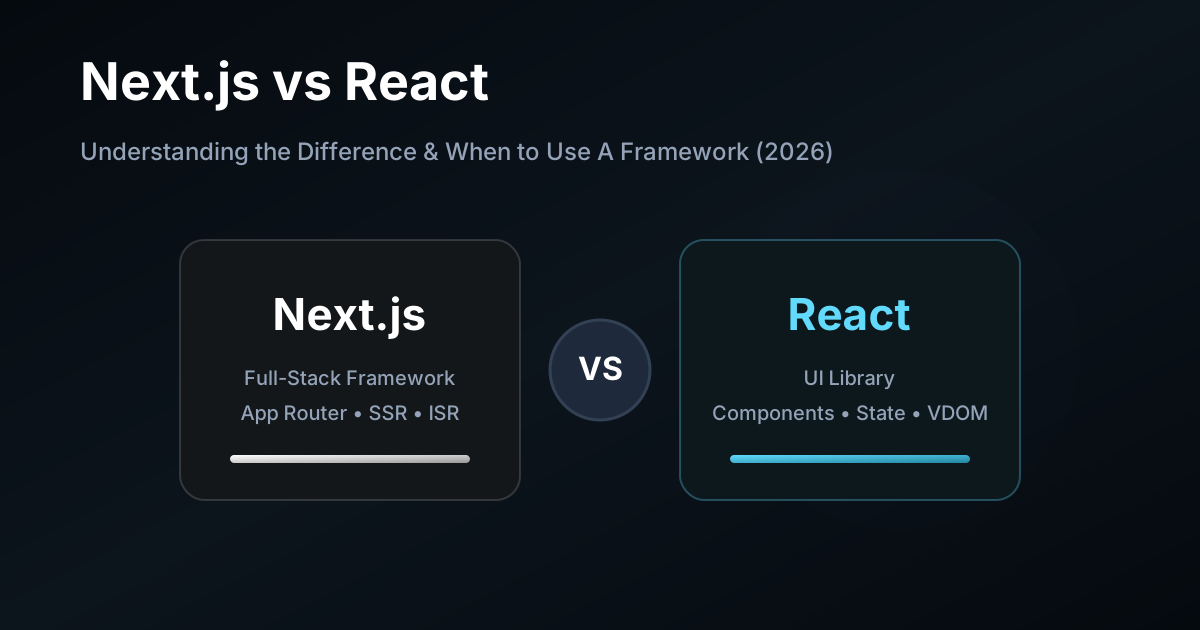
Next.js vs React: Understanding the Difference (And Why the Question Itself Is a Bit Misleading)
The “Next.js vs React” comparison is one of the most searched frontend development topics online. But the question itself is slightly misleading because React and Next.js are not direct competitors.
React is a JavaScript library focused on building user interfaces.
Next.js is a full-stack framework built on top of React.
So the real decision developers make is not:
“Should I use React or Next.js?”
Instead, the real question is:
“Should I use plain React with my own architecture, or use React inside a framework like Next.js?”
That distinction matters because both technologies solve different levels of the frontend development stack.
In this guide, we’ll explain:
- What React actually is
- What Next.js actually is
- How they relate to each other
- The differences between plain React and Next.js
- When React is the better choice
- When Next.js is the better choice
- SEO implications
- Performance differences
- Rendering strategies
- Developer experience tradeoffs
- Which approach is better in 2026
By the end, you’ll have a much clearer understanding of how modern frontend architecture actually works.
Table of Contents
- Key Takeaways
- What is React?
- What is Next.js?
- Why “Next.js vs React” Is Technically Misleading
- Core Architectural Differences
- Rendering Differences
- Routing Comparison
- SEO Comparison
- Performance Comparison
- Developer Experience
- Backend Capabilities
- When Plain React Is Better
- When Next.js Is Better
- Pros & Cons
- Comparison Table
- Frequently Asked Questions
- Final Verdict
- Related Resources
- About the Author
Key Takeaways
- React is a UI library; Next.js is a framework built on top of React.
- React focuses only on rendering interfaces and managing UI state.
- Next.js adds routing, SSR, SSG, API routes, image optimization, and full-stack features.
- Plain React gives developers more architectural control.
- Next.js provides better SEO and rendering strategies by default.
- React alone is often better for highly interactive client-heavy applications.
- Next.js is usually better for SEO-sensitive and content-focused websites.
- The real decision is convention versus control.
What is React?
React is an open-source JavaScript library maintained by Meta (formerly Facebook).
Its primary purpose is building user interfaces using reusable components.
React introduced the component-based architecture that now dominates modern frontend development.
Core Features of React
Component-Based Architecture
Applications are built using reusable UI components.
Virtual DOM
React efficiently updates only changed UI elements for better performance.
State Management
React provides tools like:
- useState
- useReducer
- useContext
to manage application state.
Declarative UI
Developers describe the UI state, and React updates the DOM automatically.
What React Does NOT Include
This is the most important thing many beginners misunderstand.
React intentionally does NOT include:
- Routing
- Backend APIs
- Authentication
- SEO rendering
- Server-side rendering
- Static site generation
- Image optimization
- Full-stack architecture
- Deployment conventions
With plain React, developers choose these pieces themselves.
This flexibility is both React’s greatest strength and one of its biggest complexities.
What is Next.js?
Next.js is a React framework created and maintained by Vercel.
It takes React and adds the missing infrastructure needed for modern web applications.
Instead of manually assembling your stack, Next.js provides built-in solutions for:
- Routing
- Server-side rendering
- Static generation
- API handling
- Performance optimization
- Image optimization
- Metadata management
- Edge rendering
- Deployment optimization
In simple terms:
React handles UI rendering. Next.js handles application architecture.
Why “Next.js vs React” Is Technically Misleading
Comparing Next.js to React is somewhat like comparing:
- Express.js vs Node.js
- Laravel vs PHP
- Django vs Python
One is a foundational library or runtime.
The other is a framework built on top of it.
You still use React inside a Next.js application.
Next.js does not replace React.
It extends React.
That’s why the actual comparison is:
| Decision | Meaning |
|---|---|
| Plain React | Build architecture yourself |
| Next.js | Use React inside a structured framework |
Core Architectural Differences
Plain React Architecture
With React alone, developers typically add:
- React Router
- Axios or Fetch
- State libraries
- Authentication tools
- SSR frameworks
- Bundlers like Vite
- Image optimization tools
This gives maximum flexibility but increases setup responsibility.
Next.js Architecture
Next.js includes:
- File-based routing
- Rendering strategies
- API routes
- Full-stack support
- Metadata APIs
- Image optimization
- Deployment optimization
This dramatically reduces configuration work.
Rendering Differences
Rendering strategy is one of the biggest differences between React and Next.js.
React Rendering
Traditional React applications primarily use:
Client-Side Rendering (CSR)
The browser downloads JavaScript first, then renders the UI.
Advantages:
- Rich interactivity
- Excellent for dashboards
- Great for client-heavy apps
Disadvantages:
- Slower initial render
- SEO challenges
- Larger JS payloads
Next.js Rendering
Next.js supports multiple rendering strategies.
Static Site Generation (SSG)
Pages are pre-generated at build time.
Best for:
- Blogs
- Documentation
- Marketing websites
Server-Side Rendering (SSR)
Pages render dynamically on the server.
Best for:
- Dynamic content
- Personalized pages
- Frequently changing data
Incremental Static Regeneration (ISR)
Combines static generation with periodic background updates.
Best for:
- Large content websites
- Ecommerce stores
- Hybrid performance models
Edge Rendering
Content is rendered closer to users globally.
Best for:
- Global applications
- Ultra-low latency experiences
Routing Comparison
React Routing
React itself does not include routing.
Developers usually install:
- React Router
and configure routes manually.
Example responsibilities include:
- Route definitions
- Navigation logic
- Dynamic routes
- Nested routes
Next.js Routing
Next.js includes built-in file-based routing.
Your folder structure automatically becomes your URL structure.
Example:
app/blog/page.tsx
automatically maps to:
/blog
Advantages include:
- Less configuration
- Faster development
- Cleaner architecture
- Better scalability
Winner: Next.js
Next.js routing is faster and simpler for most projects.
SEO Comparison
SEO is one of the biggest reasons developers choose Next.js over plain React.
React SEO Challenges
Client-side rendering creates SEO limitations because:
- Search crawlers may see incomplete HTML
- Metadata handling becomes harder
- Performance may suffer
- Initial content loading is slower
Modern crawlers are better than before, but SSR and SSG still provide major advantages.
Next.js SEO Advantages
Next.js provides:
- Server-rendered HTML
- Static pre-rendering
- Metadata APIs
- Faster first contentful paint
- Better Core Web Vitals
- Automatic performance optimization
This makes Next.js far better for:
- Blogs
- Ecommerce
- SaaS marketing pages
- Documentation sites
- Content-heavy websites
Winner: Next.js
Next.js offers significantly stronger SEO capabilities out of the box.
Performance Comparison
React Performance
React applications can perform extremely well, especially for:
- Internal dashboards
- SaaS interfaces
- Interactive web apps
However, developers must manually optimize:
- Bundles
- Images
- Rendering
- Lazy loading
- Code splitting
Next.js Performance
Next.js automatically optimizes:
- Images
- Fonts
- Route loading
- Bundle splitting
- Rendering strategies
This reduces manual optimization work significantly.
Winner: Next.js
Next.js delivers stronger default performance optimization.
Developer Experience
React Developer Experience
Advantages:
- Maximum flexibility
- Minimal abstraction
- Smaller learning surface initially
- Architecture freedom
Challenges:
- More setup work
- More architectural decisions
- More dependency management
Next.js Developer Experience
Advantages:
- Convention-driven workflows
- Built-in optimization
- Faster production setup
- Better defaults
- Strong deployment ecosystem
Challenges:
- More framework abstraction
- Opinionated architecture
- Learning Next.js conventions
Winner: Depends on Preference
- Maximum flexibility → React
- Faster production workflows → Next.js
Backend Capabilities
React Backend Support
React itself has no backend layer.
Developers typically create separate APIs using:
- Node.js
- Express
- Django
- Laravel
- Spring Boot
Next.js Backend Support
Next.js includes:
- API routes
- Server Actions
- Edge Functions
This enables lightweight full-stack applications inside a single codebase.
Winner: Next.js
Next.js dramatically simplifies full-stack frontend development.
When Plain React Is Better
Plain React makes more sense when:
- Building highly interactive dashboards
- Creating internal tools
- Developing design systems
- Building client-heavy applications
- Integrating into existing architectures
- Wanting maximum control over infrastructure
Examples include:
- Analytics dashboards
- Real-time applications
- Design editors
- Enterprise internal systems
When Next.js Is Better
Next.js is usually better when:
- SEO matters
- Performance matters
- Content visibility matters
- Building public-facing websites
- Creating SaaS landing pages
- Building ecommerce platforms
- Creating blogs or documentation
Examples include:
- Marketing websites
- Ecommerce storefronts
- SaaS platforms
- Blogs
- Documentation portals
Pros & Cons
React Pros
- Extremely flexible
- Minimal abstraction
- Huge ecosystem
- Excellent for interactive apps
- Full architecture control
React Cons
- Requires manual setup
- No built-in SSR
- No routing included
- More configuration complexity
- SEO setup is harder
Next.js Pros
- Built-in SSR and SSG
- Excellent SEO support
- File-based routing
- Strong performance defaults
- Full-stack capabilities
- Better production architecture
Next.js Cons
- More opinionated
- Increased abstraction
- Learning curve for advanced features
- Less architectural freedom
Next.js vs React: Quick Comparison Table
| Category | React | Next.js |
|---|---|---|
| Type | UI Library | React Framework |
| Routing | External library required | Built-in |
| SSR Support | Manual setup | Built-in |
| Static Generation | Manual setup | Built-in |
| SEO | Requires optimization | Strong by default |
| API Layer | External backend needed | API routes included |
| Best For | Interactive apps | SEO-focused apps |
| Architecture Control | Maximum | Convention-driven |
| Performance Optimization | Manual | Automatic |
| Learning Curve | Lower initially | Higher overall |
Frequently Asked Questions
Is Next.js better than React?
Next.js is not a replacement for React. It is a framework built on top of React. Whether it’s “better” depends on your project requirements.
Is Next.js easier than React?
For production-ready applications, yes. Next.js removes much of the setup and optimization work developers normally do manually.
Can I use React without Next.js?
Absolutely. Many applications use React directly with tools like Vite.
Is Next.js better for SEO?
Yes. Next.js provides server rendering and static generation, which improve SEO significantly.
Is React still relevant in 2026?
Yes. React remains one of the most important frontend technologies globally.
Should beginners learn React or Next.js first?
Most developers benefit from learning core React concepts first before moving into Next.js.
Final Verdict
The “Next.js vs React” debate becomes much clearer once you understand that they are not direct competitors.
React is a UI library.
Next.js is a framework built on top of React.
If you want:
- Maximum architectural control
- Client-heavy interactivity
- Custom infrastructure
- Lightweight frontend setups
then plain React remains an excellent choice.
If you want:
- SEO optimization
- Server rendering
- Better default performance
- Faster production workflows
- Full-stack capabilities
- Modern frontend conventions
then Next.js is usually the better solution.
For most public-facing modern web applications in 2026, Next.js has become the default recommendation because it solves many frontend infrastructure problems automatically.
But plain React remains incredibly valuable for highly customized applications where flexibility matters more than framework conventions.
Ultimately, the best choice depends on what you’re building — not which technology is more popular.
Related Resources
- Next.js vs Nuxt.js Comparison
- React Performance Optimization Guide
- SSR vs CSR vs SSG Explained
- Best Frontend Frameworks in 2026
- Vite vs Next.js Comparison
About the Author
VSNEXOS Editorial Team specializes in frontend engineering, web performance optimization, modern JavaScript ecosystems, cloud deployment, and scalable web architecture.
The team creates developer-focused guides, framework comparisons, technical tutorials, and modern web development resources for startups, agencies, and engineering teams.
Building enterprise SaaS for Indian businesses from Hyderabad.
LinkedIn