Firebase vs Supabase: Which Backend-as-a-Service Should You Choose in 2026?
Compare Firebase and Supabase across database architecture, authentication, pricing, scalability, real-time features, open-source flexibility, and vendor lock-in to choose the right backend platform.
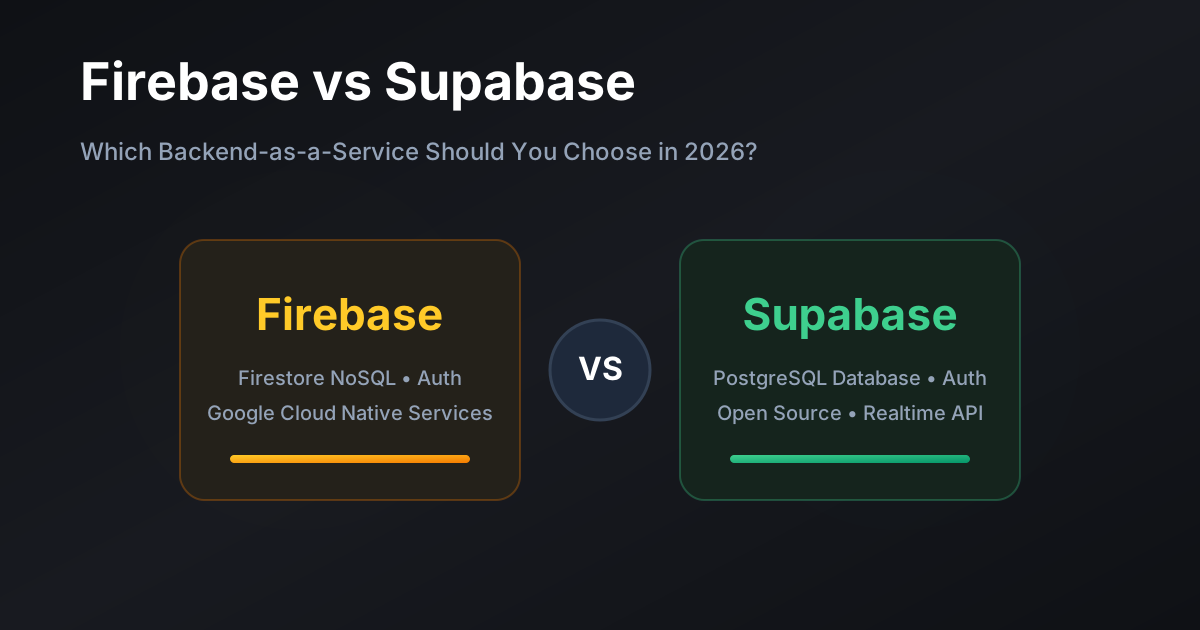
Firebase vs Supabase: Which Backend-as-a-Service Should You Choose in 2026?
Modern application development has changed dramatically over the last few years.
Developers increasingly want to build products without spending weeks managing backend infrastructure, configuring databases, handling authentication, setting up real-time synchronization, or maintaining cloud servers manually.
That’s why Backend-as-a-Service (BaaS) platforms have become so popular.
Two of the biggest platforms dominating this space in 2026 are Firebase and Supabase.
Both platforms provide:
- Databases
- Authentication
- Storage
- Real-time functionality
- APIs
- Serverless infrastructure
- Developer tooling
But despite solving similar problems, Firebase and Supabase are built on fundamentally different architectural philosophies.
Firebase is heavily centered around Google’s proprietary NoSQL ecosystem.
Supabase is built around open-source PostgreSQL infrastructure.
That single difference shapes nearly every other decision in this comparison.
So which backend platform is actually better in 2026?
The answer depends on:
- Your data structure
- Scalability requirements
- Vendor lock-in tolerance
- SQL vs NoSQL preferences
- Team expertise
- Real-time requirements
- Mobile app priorities
- Infrastructure flexibility
In this detailed comparison, we break down Firebase vs Supabase across:
- Database architecture
- Authentication
- Real-time capabilities
- Scalability
- Pricing
- Security
- Performance
- Open-source flexibility
- Vendor lock-in
- Developer experience
By the end of this guide, you’ll know exactly which backend platform is the better fit for your project.
Table of Contents
- Key Takeaways
- What is Firebase?
- What is Supabase?
- Core Architectural Differences
- Database Comparison
- Authentication Comparison
- Real-Time Features
- Scalability
- Vendor Lock-In
- Pricing Comparison
- Performance
- Developer Experience
- Security
- Open Source & Self-Hosting
- AI & Modern Features
- Pros & Cons
- Comparison Table
- Best For Different Users
- Frequently Asked Questions
- Final Verdict
- Related Resources
- About the Author
Key Takeaways
- Firebase uses a NoSQL document database called Firestore.
- Supabase is built directly on PostgreSQL.
- Supabase is open-source and self-hostable.
- Firebase has stronger mobile ecosystem maturity.
- Supabase offers better SQL querying and relational modeling.
- Firebase integrates deeply with Google Cloud services.
- Supabase significantly reduces vendor lock-in risks.
- Firebase is often easier for rapid mobile prototyping.
- Supabase is generally better for relational applications and long-term portability.
What is Firebase?
Firebase is a Backend-as-a-Service platform developed by Google.
It provides developers with tools for:
- Databases
- Authentication
- Hosting
- Cloud Functions
- Analytics
- Real-time synchronization
- Push notifications
- Mobile infrastructure
Firebase became especially popular among mobile developers because it dramatically simplified backend development for Android and iOS applications.
Its core database product today is:
- Cloud Firestore
which uses a NoSQL document-based architecture.
Core Advantages of Firebase
Deep Google Ecosystem Integration
Firebase works seamlessly with:
- Google Cloud
- Analytics
- Crashlytics
- Cloud Functions
- Google Authentication
Strong Mobile SDKs
Firebase has extremely mature SDK support for:
- Android
- iOS
- Flutter
- React Native
Real-Time Synchronization
Real-time updates are built directly into Firestore.
Fast Prototyping
Developers can build MVPs quickly without infrastructure management.
Managed Scalability
Google manages infrastructure scaling automatically.
What is Supabase?
Supabase is an open-source Backend-as-a-Service platform built on PostgreSQL.
It positions itself as:
“The open-source Firebase alternative.”
Unlike Firebase’s proprietary NoSQL architecture, Supabase uses relational PostgreSQL databases underneath.
Supabase includes:
- PostgreSQL database
- Authentication
- Storage
- Real-time subscriptions
- Edge Functions
- APIs
- Vector support
- Row-level security
Because it uses PostgreSQL, Supabase provides developers with standard SQL capabilities and reduced vendor lock-in.
Core Advantages of Supabase
PostgreSQL Foundation
Developers get full SQL support and relational modeling.
Open Source
Supabase can be self-hosted and customized.
Reduced Vendor Lock-In
Projects remain portable because PostgreSQL is an industry standard.
Row-Level Security
Fine-grained access control is built directly into PostgreSQL.
Strong Developer Experience
Modern APIs and tooling simplify backend workflows.
Core Architectural Differences
The biggest difference between Firebase and Supabase is database architecture.
Firebase Architecture
Firebase centers around:
- Firestore
- NoSQL document storage
- Google Cloud infrastructure
Data is stored in collections and documents.
Example:
{
  "name": "Alice",
  "email": "alice@example.com"
}
Advantages include:
- Flexible schemas
- Rapid iteration
- Easy document storage
Challenges include:
- Complex relational modeling
- Data duplication
- Vendor lock-in
Supabase Architecture
Supabase uses PostgreSQL relational databases.
Example:
CREATE TABLE users (
  id SERIAL PRIMARY KEY,
  name TEXT,
  email TEXT UNIQUE
);
Advantages include:
- SQL querying
- Relational integrity
- Structured data
- Advanced analytics
Challenges include:
- More schema planning
- Less flexibility for unstructured data
Database Comparison
Firebase Database Model
Firestore is a document database.
Best suited for:
- Dynamic content
- Flexible structures
- Mobile synchronization
- Rapid prototyping
However, relational querying often becomes more complicated.
Supabase Database Model
Supabase uses PostgreSQL.
Best suited for:
- Relational systems
- SaaS applications
- Ecommerce
- Analytics
- Structured datasets
SQL joins and relationships are handled naturally.
Winner: Supabase
For most modern business applications, PostgreSQL provides stronger long-term flexibility and querying power.
Authentication Comparison
Firebase Authentication
Firebase Auth supports:
- Email/password login
- Google login
- Apple login
- Phone authentication
- OAuth providers
Its mobile SDK integration is extremely mature.
Supabase Authentication
Supabase Auth supports:
- Magic links
- OAuth providers
- Email/password login
- JWT authentication
- Row-level security integration
The PostgreSQL integration provides powerful authorization workflows.
Winner: Depends on Use Case
- Mobile-first apps → Firebase
- SQL-based systems → Supabase
Real-Time Features
Firebase Real-Time Sync
Real-time synchronization is one of Firebase’s strongest features.
Firestore listeners update clients instantly when data changes.
This makes Firebase excellent for:
- Chat apps
- Collaborative apps
- Live dashboards
- Real-time mobile experiences
Supabase Real-Time Features
Supabase provides real-time subscriptions built on PostgreSQL replication.
Capabilities include:
- Live database updates
- Real-time subscriptions
- Presence systems
- Broadcast messaging
The system is powerful and continues improving rapidly.
Winner: Firebase
Firebase still has the more mature real-time ecosystem overall.
Scalability
Firebase Scalability
Firebase scales automatically using Google infrastructure.
Advantages include:
- Auto-scaling
- Global infrastructure
- Managed operations
- Enterprise-grade cloud systems
This dramatically simplifies operational management.
Supabase Scalability
Supabase scales well using PostgreSQL infrastructure.
Features include:
- Read replicas
- Database scaling
- Edge functions
- Managed cloud hosting
However, extremely large-scale distributed systems may require more architectural planning.
Winner: Firebase
Firebase provides simpler large-scale operational scaling.
Vendor Lock-In
Vendor lock-in is one of the most important long-term considerations.
Firebase Vendor Lock-In
Firebase is deeply tied to:
- Google Cloud
- Firestore APIs
- Proprietary NoSQL architecture
Migrating away later can become difficult and expensive.
Supabase Vendor Lock-In
Supabase uses:
- PostgreSQL
- Open standards
- Open-source tooling
Projects remain significantly more portable.
Winner: Supabase
Supabase dramatically reduces long-term lock-in risks.
Pricing Comparison
Firebase Pricing
Firebase pricing scales based on:
- Database reads
- Writes
- Storage
- Network usage
- Cloud Functions
Large-scale Firestore usage can become expensive unexpectedly.
Supabase Pricing
Supabase pricing typically scales through:
- Database size
- Bandwidth
- Compute resources
SQL workloads are often easier to estimate predictably.
Winner: Depends on Usage
- Small prototypes → Firebase
- Relational production systems → Supabase
Performance
Firebase Performance
Firestore performs extremely well for:
- Real-time sync
- Mobile workloads
- Global client delivery
- Document retrieval
However, complex relational querying becomes harder.
Supabase Performance
Supabase benefits from PostgreSQL performance strengths including:
- SQL optimization
- Relational querying
- Advanced indexing
- Aggregations
- Reporting
Winner: Depends on Workload
- Real-time document sync → Firebase
- Relational analytics → Supabase
Developer Experience
Firebase Developer Experience
Firebase simplifies backend development significantly.
Advantages:
- Strong documentation
- Excellent SDKs
- Fast onboarding
- Tight Google integration
Challenges:
- Proprietary query patterns
- Firestore-specific architecture learning
Supabase Developer Experience
Supabase feels especially natural for developers familiar with SQL.
Advantages include:
- Standard PostgreSQL workflows
- Auto-generated APIs
- SQL flexibility
- Open-source tooling
Winner: Supabase
Supabase provides a more transferable and standards-based developer experience.
Security
Firebase Security
Firebase provides:
- Authentication systems
- Security rules
- Google Cloud infrastructure security
- Enterprise-grade hosting
However, Firestore security rules can become complex.
Supabase Security
Supabase uses PostgreSQL row-level security (RLS).
Advantages include:
- Fine-grained access control
- SQL-based authorization
- Enterprise-grade PostgreSQL security
Winner: Supabase
Row-level security provides extremely powerful authorization control.
Open Source & Self-Hosting
Firebase Hosting Model
Firebase is fully proprietary.
Users cannot self-host Firebase infrastructure.
Supabase Open-Source Model
Supabase is fully open-source.
Developers can:
- Self-host
- Customize infrastructure
- Avoid platform dependency
- Control deployment environments
Winner: Supabase
Supabase provides dramatically greater infrastructure freedom.
AI & Modern Features
Firebase AI Ecosystem
Firebase integrates well with:
- Google AI tools
- Cloud AI services
- Vertex AI
This benefits teams already using Google Cloud infrastructure.
Supabase AI Features
Supabase increasingly supports:
- Vector databases
- AI embeddings
- Semantic search
- AI application workflows
The PostgreSQL ecosystem is becoming highly attractive for AI systems.
Winner: Tie
Both platforms are evolving rapidly for AI workloads.
Pros & Cons
Firebase Pros
- Excellent mobile SDKs
- Strong real-time sync
- Fast onboarding
- Managed scaling
- Deep Google ecosystem integration
Firebase Cons
- Proprietary architecture
- Vendor lock-in risks
- Complex relational modeling
- Firestore pricing unpredictability
Supabase Pros
- PostgreSQL foundation
- Open-source flexibility
- SQL querying
- Lower lock-in risk
- Strong relational modeling
- Self-hosting support
Supabase Cons
- Slightly newer ecosystem
- Less mature mobile tooling
- More schema planning required
- Distributed scaling can require more expertise
Comparison Table
| Feature | Firebase | Supabase |
|---|---|---|
| Database Type | NoSQL (Firestore) | PostgreSQL |
| Open Source | No | Yes |
| Self-Hosting | No | Yes |
| Real-Time Sync | Excellent | Very Good |
| SQL Support | Limited | Excellent |
| Relational Data | Moderate | Excellent |
| Mobile SDKs | Excellent | Good |
| Vendor Lock-In | High | Low |
| Scalability | Excellent | Very Good |
| Developer Flexibility | Moderate | Excellent |
Best For Different Users
Best for Mobile Apps
Winner: Firebase
Firebase remains extremely strong for mobile-first development.
Best for Relational Applications
Winner: Supabase
PostgreSQL provides stronger relational modeling.
Best for Startups
Winner: Depends on Product
- Rapid MVPs → Firebase
- Long-term scalable SaaS → Supabase
Best for Enterprises
Winner: Supabase
Reduced vendor lock-in matters significantly at scale.
Best for AI Applications
Winner: Supabase
PostgreSQL vector support is increasingly powerful for AI workflows.
Frequently Asked Questions
Is Supabase better than Firebase?
For relational applications and long-term portability, many developers prefer Supabase. Firebase remains extremely strong for mobile and real-time systems.
Can Supabase replace Firebase?
Yes, for many applications. However, migrating requires restructuring data models because PostgreSQL and Firestore work very differently.
Is Firebase still worth using in 2026?
Absolutely. Firebase remains one of the most powerful backend platforms available, especially for mobile ecosystems.
Why do developers prefer Supabase?
Many developers prefer Supabase because it uses PostgreSQL and open standards instead of proprietary infrastructure.
Which backend is cheaper?
It depends heavily on workload patterns. Firebase costs can rise quickly with read-heavy applications, while Supabase pricing is often easier to predict.
Which platform is better for startups?
- Fast mobile MVPs → Firebase
- Long-term SaaS infrastructure → Supabase
Final Verdict
Both Firebase and Supabase are outstanding Backend-as-a-Service platforms in 2026, but they target different architectural priorities.
Choose Firebase if you want:
- Mature mobile infrastructure
- Deep Google integration
- Powerful real-time synchronization
- Rapid prototyping
- Fully managed scalability
Choose Supabase if you need:
- PostgreSQL relational databases
- SQL querying
- Open-source flexibility
- Reduced vendor lock-in
- Self-hosting capabilities
- Long-term portability
For many modern SaaS applications and relational systems, Supabase’s PostgreSQL foundation provides stronger long-term architectural flexibility.
But for mobile-first applications and highly real-time systems deeply integrated with Google Cloud, Firebase remains extremely compelling.
Ultimately, the best backend platform depends on your data model, infrastructure priorities, scaling strategy, and long-term business goals.
Related Resources
- Firebase vs Appwrite Comparison
- PostgreSQL vs MongoDB Guide
- Best Backend-as-a-Service Platforms
- SQL vs NoSQL Explained
- Supabase Authentication Guide
About the Author
VSNEXOS Editorial Team specializes in backend architecture, cloud infrastructure, modern databases, scalable SaaS systems, and developer tooling.
The team creates technical guides, backend comparisons, cloud tutorials, and infrastructure resources for startups, enterprises, and engineering teams.
Building enterprise SaaS for Indian businesses from Hyderabad.
LinkedIn