How AI Automation Can Save Indian Businesses Lakhs of Rupees in 2026
Discover how AI automation helps Indian businesses reduce costs, eliminate repetitive work, improve customer service, and increase profits. Learn real-world examples and implementation strategies for 2026.
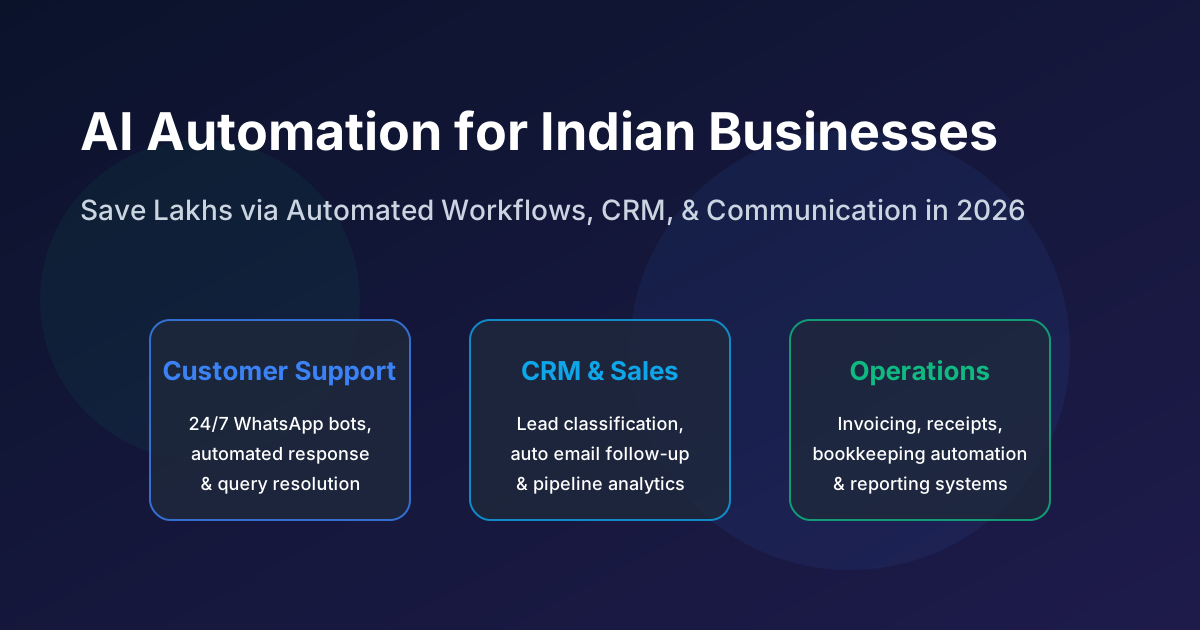
How AI Automation Can Save Indian Businesses Lakhs of Rupees in 2026
In 2026, businesses are no longer competing solely on products and pricing. They are competing on speed, efficiency, customer experience, and operational excellence.
Yet thousands of Indian businesses still rely on manual processes, spreadsheets, WhatsApp messages, paper records, and repetitive administrative tasks. These outdated workflows consume valuable employee time, increase operational costs, and slow down growth.
Artificial Intelligence (AI) and Business Automation are changing this reality.
Businesses that automate their operations are saving hundreds of hours every month, reducing errors, improving customer satisfaction, and increasing profitability. For many small and medium businesses, automation is no longer a luxury—it has become a competitive necessity.
What is AI Automation?
AI Automation combines artificial intelligence with workflow automation to perform repetitive tasks without constant human intervention.
Instead of employees manually entering data, sending reminders, generating reports, or responding to common customer queries, AI systems can handle these activities automatically.
Examples include:
- Automated invoice generation
- AI-powered customer support
- Employee attendance tracking
- Lead management systems
- Automated email campaigns
- Inventory monitoring
- Appointment scheduling
- Financial reporting
The goal is simple: allow people to focus on decision-making while machines handle repetitive work.
Why Indian Businesses Are Losing Money
Many organizations underestimate how much money is lost through inefficient processes.
Common problems include:
Manual Data Entry
Employees spend hours entering information into spreadsheets, CRM systems, and accounting software.
Consequences:
- Human errors
- Duplicate entries
- Delayed reporting
- Increased labor costs
Missed Sales Opportunities
Many businesses receive inquiries through:
- Phone calls
- Website forms
- Social media
Without automation, leads are often forgotten or contacted too late.
Every missed lead represents lost revenue.
Delayed Customer Support
Customers expect immediate responses.
Slow support leads to:
- Negative reviews
- Reduced trust
- Lower customer retention
Inefficient Reporting
Managers frequently spend days preparing reports that could be generated automatically in minutes.
Real Cost of Manual Operations
Consider a company with 10 employees.
If each employee spends:
- 2 hours per day on repetitive administrative work
That equals:
- 20 hours daily
- 100 hours weekly
- 400+ hours monthly
At an average cost of ₹300 per hour:
- ₹1,20,000 per month
- ₹14,40,000 per year
This hidden operational expense often goes unnoticed.
Automation can significantly reduce these costs.
How AI Automation Works
Modern automation systems connect multiple business processes into a unified workflow.
A typical workflow might look like this:
- Customer submits inquiry
- AI captures lead details
- CRM automatically creates record
- WhatsApp confirmation sent
- Sales team notified instantly
- Follow-up reminders scheduled
- Reports generated automatically
No manual intervention required.
The result is faster operations and better customer experience.
Real-World Automation Examples
Clinic Management Automation
Many clinics still manage appointments manually.
Automation can:
- Schedule appointments automatically
- Send reminders
- Generate prescriptions
- Manage billing
- Maintain patient records
Benefits:
- Reduced waiting times
- Better patient experience
- Lower administrative workload
Retail Store Automation
Retail businesses handle inventory, billing, payments, and customer management daily.
Automation enables:
- Real-time inventory tracking
- Automated low-stock alerts
- Digital invoicing
- Sales analytics
Benefits:
- Reduced inventory losses
- Faster billing
- Better forecasting
HR and Payroll Automation
Human resource departments often spend significant time processing attendance and payroll.
AI systems can:
- Track attendance
- Calculate payroll
- Manage leave requests
- Generate reports
Benefits:
- Fewer payroll errors
- Faster processing
- Improved compliance
Lead Management Automation
Many businesses lose potential customers because follow-ups are delayed.
AI-powered lead automation can:
- Capture leads instantly
- Score lead quality
- Schedule follow-ups
- Send personalized messages
Benefits:
- Higher conversion rates
- Faster sales cycles
- Better customer engagement
Technologies Powering Business Automation
Modern businesses use a combination of tools and technologies:
AI Agents
AI agents perform tasks such as:
- Customer support
- Data analysis
- Lead qualification
- Report generation
Workflow Automation Platforms
Tools like:
- n8n
- Make
- Zapier
connect multiple systems and automate workflows.
WhatsApp Business API
Allows businesses to:
- Send reminders
- Confirm appointments
- Deliver invoices
- Engage customers
CRM Systems
Customer Relationship Management platforms centralize customer information and automate sales processes.
Benefits of AI Automation
Reduced Operational Costs
Automation reduces repetitive manual work, lowering staffing requirements and administrative expenses.
Increased Productivity
Employees can focus on strategic and revenue-generating activities.
Better Customer Experience
Customers receive faster responses and more consistent service.
Improved Accuracy
Automated systems eliminate many human errors.
Scalability
Businesses can handle increased workloads without proportionally increasing staff.
Common Myths About Automation
Myth 1: Automation Replaces Employees
Reality:
Automation replaces repetitive tasks, not people.
Employees become more productive and valuable.
Myth 2: Automation Is Only for Large Companies
Reality:
Modern automation solutions are affordable for startups and small businesses.
Myth 3: Implementation Is Complicated
Reality:
Many workflows can be automated in weeks, not months.
How to Start Automating Your Business
Step 1: Identify Repetitive Tasks
Look for activities performed daily or weekly.
Step 2: Measure Time Consumption
Determine how much time employees spend on each process.
Step 3: Prioritize High-Impact Workflows
Start with tasks that provide the biggest return on investment.
Step 4: Implement Gradually
Automate one process at a time.
Step 5: Monitor Results
Track improvements in productivity, cost savings, and customer satisfaction.
How VSNEXOS Helps Businesses Automate Operations
At VSNEXOS, we help businesses design and implement intelligent automation solutions tailored to their operations.
Our services include:
- Business Process Automation
- AI-Powered Workflows
- CRM Development
- Custom SaaS Platforms
- WhatsApp Automation
- AI Chatbots
- Web Application Development
- Workflow Integration
We focus on creating scalable systems that help organizations reduce costs, improve efficiency, and accelerate growth.
The Future of Business Automation in India
India's digital economy continues to grow rapidly.
Businesses that embrace automation today will be better positioned to:
- Scale operations
- Improve customer experiences
- Increase profitability
- Compete in global markets
The organizations that thrive in 2026 and beyond will not necessarily be the largest—they will be the most efficient.
Conclusion
AI Automation is transforming the way businesses operate.
From customer support and lead management to payroll processing and inventory tracking, automation helps organizations save time, reduce costs, and improve performance.
For Indian businesses looking to grow efficiently, automation is one of the highest-return investments available today.
The question is no longer whether businesses should automate.
The question is how quickly they can begin.
Building enterprise SaaS for Indian businesses from Hyderabad.
LinkedIn